|
The power of
Yantras to
induce resonance
is based on the
specific form of
its appearance.
Such a diagram
can be composed
from one or more
geometrical
shapes which
combine into a
precise model
representing and
transfiguring in
essence, at the
level of the
physical
universe, the
subtle sphere of
force
corresponding to
the invoked
deity. From this
point of view we
can argue that
the Yantra
functions
similarly to a
mantra (sacred
word). By
resonance, a
certain energy
from the
practitioner's
microcosm
vibrates on the
same wavelength
with the
corresponding
infinite energy
present in the
macrocosm,
energy which is
represented in
the physical
plane by the
Yantra. The
principle of
resonance with
any deity,
cosmic power,
aspect,
phenomenon or
energy owes its
universal
applicability to
the perfect
correspondence
existing between
the human being
(seen as a true
microcosm) and
the Creation as
a whole
(macrocosm).
 The
Yantric Contour The
Yantric Contour
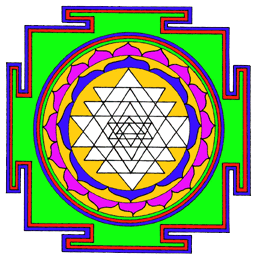
Every Yantra is
delimited from
the exterior by
a line or a
group of lines
forming its
perimeter. These
marginal lines
have the
function to
maintain,
contain and
prevent the loss
of the magical
forces
represented by
the core
structure of the
Yantra, usually
the central dot.
They also have
the function to
increase its
magical and
subtle force.
The core of the
Yantra is
composed of one
or several
simple
geometrical
shapes: dots,
lines,
triangles,
squares, circles
and lotuses
representing in
different ways
the subtle
energies.
The Dot (bindu)
For example, the
dot (• or
the bindu)
signifies the
focalized energy
and its intense
concentration.
It can be
evnisaged as a
kind of energy
deposit which
can in turn
radiate energy
under other
forms. The dot
is usually
surrounded by
different
surfaces, either
a triangle, a
hexagon, a
circle etc.
These forms
depend on the
characteristic
of the deity or
aspect
represented by
the Yantra. In
the tantric
iconography, the
dot is named
bindu; in tantra bindu
is symbolically
considered to be
Shiva himself,
the source of
the whole
creation.
 The
Tiangle (trikona) The
Tiangle (trikona)
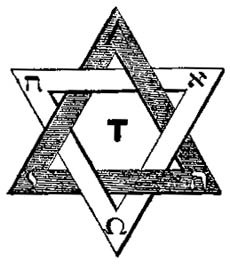
The triangle (trikona)
is the symbol of
Shakti, the
feminine energy
or aspect of
Creation. The
triangle
pointing down
represents the
yoni, the
feminine sexual
organ and the
symbol of the
supreme source
of the Universe,
and when the
triangle is
pointing upwards
it signifies
intense
spiritual
aspiration, the
sublimation of
one's nature
into the most
subtle planes
and the element
of fire (Agni
Tattva). The
fire is always
oriented
upwards, thus
the correlation
with the upward
triangle - Shiva
kona. On the
other hand, the
downward
pointing
triangle
signifies the
element of water
which always
tends to flown
and occupy the
lowest possible
position. This
triangle is
known as Shakti
kona.
The intersection
of two geometric
forms (lines,
triangles,
circles, etc.)
represents
forces that are
even more
intense than
those generated
by the simple
forms. Such an
interpenetration
indicates a high
level in the
dynamic
interaction of
the
correspondent
energies. The
empty spaces
generated by
such
combinations are
described as
very efficient
operational
fields of the
forces emanating
from the
centeral point
of the Yantra.
That is why we
can very often
encounter
representations
of mantraS in
such spaces.
Yantra and
mantra are
complementary
aspects of Shiva
and their use
together is much
more efficient
than the use of
one alone.
 The Six
Points Star (shatkona) The Six
Points Star (shatkona)
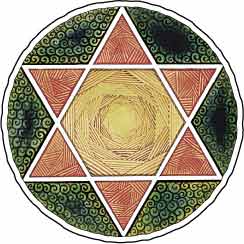
A typical
combination
often found in
the graphical
structure of a
Yantra is the
superposition of
two triangles,
one pointing
upwards and the
other downwards,
forming a star
with six points
(shatkona), also
known as David's
Star. This form
symbolically
represents the
union of Purusha
and Prakriti or
Shiva-Shakti,
without which
there could be
no Creation.
The Circle (chakra)
Another simple
geometrical
shape often used
in Yantras is
the circle,
representing the
rotation, a
movement closely
linked to the
shape of spiral
which is
fundamental in
the Macrocosmic
evolution. At
the same time,
the circle
represents
perfection and
the blissful
creative void.
In the series of
the five
fundamental
elements it
represents air (Vayu
Tattva).
The Square (bhupura)
Between the
simple
geometrical
elemets that
compose Yantras
there is also
the sqaure (bhupura).
The square is
usually the
exterior limit
of the Yantra
and
symbolically, it
represents the
element earth (Prithivi
Tattva).
Every Yantra
starts from the
center, often
marked by a
central dot (bindu)
and ends with
the outer
square. This
represents the
sense of
universal
evolution,
starting from
the subtle and
ending with the
coarse, starting
from "ether" and
ending with
"earth".
Even tough most
of the times
Yantras are
composed of
these simple
geometrical
shapes,
sometimes we
encounter other
elements such as
arrow points,
tridents,
swords, spikes
included in the
design of a
Yantra with the
purpose of
representing
vectors and
directions of
action for the
Yantric
energies.
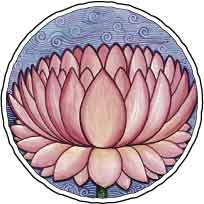 The
Lotus (padma) The
Lotus (padma)
The lotus symbol
(or its petals)
is both a symbol
of purity and
variety, every
lotus petal
representing a
distinct aspect.
The inclusion of
a lotus in a
Yantra
represents
freedom from
multiple
interference
with the
exterior
(purity) and
expresses the
absolute force
of the Supreme
Self.
In conclusion, a
Yantra is a very
complex
spiritual
instrument in
the tantric
practice (sadhana).
It can calm and
focus the
activities of
the mind, and by
its positive
auto-suggestion
it has a benefic
impact on the
health and
psychic well
being of a
person.
A Yantra alone
represents
nothing. Only
when it is
awakened by
mental
concentration
and meditation
will the process
of resonance
appear and the
benefic
macrocosmic
energies will
manifest
themselves in
the
practitioner's
microcosm. |